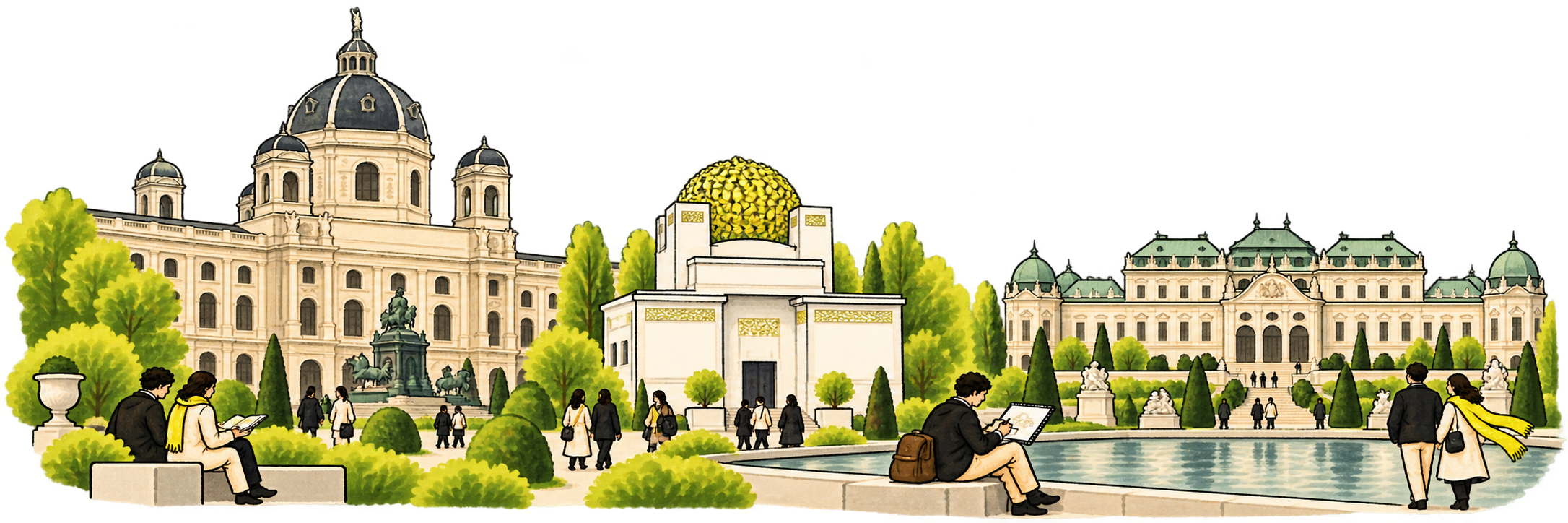
THE VIENNA ART GUIDE
24 Famous Artworks in Vienna and Where to See Them
Royal portraits, uneasy embraces and a salt cellar fit for a king, with the stories that make Vienna’s collections worth a longer look.
Klimt’s lovers glitter with gold, silver and platinum. Elsewhere in the Belvedere, Napoleon crosses the Alps on a horse substituted for the mule he actually rode. Vienna’s collections are full of these acts of transformation: bodies become ornament, a tree trunk becomes a courtly compliment, and a salt cellar contains a miniature royal universe. The smaller details often lead to the larger story. These 24 works are grouped by collection, with room for the famous paintings and for the objects, portraits and unfinished mysteries that can change the character of a museum visit.

Find the collections
5 museums, with the works grouped below. Choose the collections that interest you and check opening hours in the museum guides.
Use two fingers to move or pinch the map on a touch screen; one finger scrolls the page. In full screen, drag to move. Use plus and minus to zoom. Arrow keys move the map; zero fits all stops. Escape closes the preview or full screen.
Venue coordinates: OpenStreetMap and GeoNames.
Twelve works to start with
Upper Belvedere: gold, power and the uneasy embrace
Klimt makes bodies dissolve into decoration; Schiele gives closeness an awkward physical weight. David’s Napoleon adds a different kind of invention to the same collection.
Plan a visit to Upper Belvedere01 /24
The Kiss (Lovers)
Gustav Klimt · c. 1907–1909
The glitter is real gold, silver and platinum. Different robe patterns separate two bodies that otherwise merge into a single golden shape.
The metals in this embrace are real: gold, silver and platinum give Klimt’s surface a changing light that a reproduction can only suggest. Pattern does much of the embracing, too. The lovers’ robes almost join into one golden form, while the woman’s bare feet hold the scene to its flower-covered patch of ground. Klimt painted the picture without a commission and showed it as Lovers at the 1908 Kunstschau. The state bought it for the gallery that became the Belvedere. Its now inseparable title, The Kiss, followed in the museum’s 1909 catalogue; this familiar image acquired its familiar name along the way.
Collection record at Upper Belvedere
02 /24
Judith
Gustav Klimt · 1901
Holofernes’ severed head is almost pushed out of the frame. Klimt gives the entire image to Judith’s unsettling, half-closed gaze.
The severed head nearly escapes notice. Klimt crops Holofernes into the lower corner, leaving Judith’s half-closed eyes, parted lips and glittering jewellery to command the picture. In the biblical story she saves her people by killing the enemy commander; here, the deed is revealed only after her presence has registered. That delayed recognition makes the gold feel more unsettling. Fine coloured strokes give her skin a softness that the surrounding ornament refuses. Painted in 1901, Judith offers an early, concentrated encounter with the combination of living flesh and flat decoration that would become central to Klimt’s Golden Period.
Collection record at Upper Belvedere
03 /24
Fritza Riedler
Gustav Klimt · 1906
The chair turns into a pattern of waves and Egyptian-looking eyes. Her carefully modelled face seems to float above the ornament.
The chair is almost a second subject. Bands of waves and eye-like motifs spread around Fritza Riedler, turning her seat into an elaborate pattern whose flatness makes her face appear especially present. Riedler was the wife of a successful mechanical engineer; Klimt gives her the stillness and frontal authority of an enthroned figure. Her dark hair anchors the pale face, and the softness of her white dress interrupts the room’s geometry. Spend a moment following where the furniture stops behaving like furniture. The portrait’s peculiar intimacy comes from the survival of a recognisable person within an environment becoming ornament.
Collection record at Upper Belvedere
04 /24
Death and the Maiden
Egon Schiele · 1915
The woman clings tightly while the man looks beyond her. The embrace feels precarious rather than secure.
Wally Neuzil’s arms close around Schiele, but his gaze seems to go somewhere she cannot follow. The museum identifies the pair as the artist and his long-term partner and model, whom he left before marrying Edith Harms. That history gives the old theme of Death and the Maiden a painfully personal setting. Their bodies balance awkwardly on barren ground, with little sense of a secure place to rest. Painted in 1915, the scene predates Wally’s death during wartime nursing service by two years. Its immediate story is a separation between living people, expressed through an embrace that cannot seem to hold them together.
Collection record at Upper Belvedere
05 /24
The Embrace
Egon Schiele · 1917
The upper bodies cling together while the lower bodies drift apart. A crumpled white sheet carries almost as much tension as the limbs.
The white sheet is restless. Its sharp folds spread around two naked lovers, echoing the angles of limbs and making the space beyond their bodies feel almost as charged as the embrace itself. Schiele has removed the ordinary room and the direct, confronting gaze familiar from his portraits. Emotion travels through posture instead: arms and upper bodies draw tightly together, while the lower bodies begin to drift apart. Painted in 1917, this is a later exploration of intimacy than Death and the Maiden. Seen together, the two paintings show how much uncertainty Schiele could put into the apparently simple act of holding someone.
Collection record at Upper Belvedere
06 /24
Napoleon at the Great St Bernard Pass
Jacques-Louis David · 1801
Napoleon actually crossed on a mule. David supplies a rearing horse and carves Hannibal and Charlemagne into the rocks to build a heroic legend.
The mule has been edited out of history. Napoleon crossed the Great St Bernard Pass on one in May 1800; David supplies a rearing horse, a flying cloak and a commander untouched by the surrounding turmoil. Far below him, soldiers struggle through the crossing. The rocks do their share of the persuasion, carrying the names of Hannibal and Charlemagne alongside Bonaparte and placing the recent general in an illustrious sequence. This version was intended for Milan before entering the imperial collection in Vienna. The horse’s agitation and the rider’s composure make the same claim: here is a man capable of directing forces larger than himself.
Collection record at Upper BelvedereKunsthistorisches Museum: worlds inside a painting
A studio opens onto history, a winter valley teems with activity, and an impossible tower becomes an absorbing building site. These pictures reward moving between the whole scene and its smallest actions.
Plan a visit to Kunsthistorisches Museum
07 /24
The Art of Painting
Johannes Vermeer · c. 1666–1668
The model plays Clio, muse of history. The map behind her shows the Netherlands before its division into north and south.
A curtain is pulled aside, and we are admitted to a studio in which almost everything has a second purpose. The model is Clio, muse of history, so the painter’s work becomes a claim about art’s ability to preserve fame. Behind her, a map gathers the seventeen provinces of the Netherlands before their political division. The room quietly contains a much larger world. Objects associated with sculpture, drawing and painting bring the arts into the same conversation. Vermeer’s achievement is to keep all that meaning within the persuasive calm of an interior: light, fabric and the business of making an image still hold the eye.
Collection record at Kunsthistorisches Museum
08 /24
Hunters in the Snow
Pieter Bruegel the Elder · 1565
The returning hunters have only a fox to show for their effort. Far below them, skaters turn the frozen ponds into a playground.
The hunters have brought back a single fox. Their lowered heads, the dogs’ weary progress and the dark tree trunks make the foreground feel cold and effortful. Farther down the slope, winter offers a different occupation: villagers skate and play on the frozen ponds. Beside the inn, a fire is being prepared for singeing a pig. Bruegel painted the landscape as part of a six-picture cycle of the year, giving work and recreation a place within the season’s larger rhythms. The distant figures are tiny, but each activity helps turn this sweeping snowy valley into a place where life is continuing.
Collection record at Kunsthistorisches Museum
09 /24
The Tower of Babel
Pieter Bruegel the Elder · 1563
The town around the tower makes its impossible scale clear. Zoom in mentally and the monument becomes hundreds of individual building jobs.
A project of impossible size becomes a collection of very plausible jobs. Bruegel scatters masons, machinery, passages and unfinished walls across the Tower of Babel, letting the eye move between the scale of a single worker and the enormity of the undertaking. Around its base, a harbour city recalls the Netherlands; the tower combines ancient and Romanesque architectural forms. The biblical ambition to build toward heaven sits inside an exceptionally absorbing construction scene. Follow a storey around the curve and finished masonry gives way to work still exposed. The painting makes it possible to admire the builders’ ingenuity while sensing the absurd scale of their task.
Collection record at Kunsthistorisches Museum
10 /24
The Peasant Wedding
Pieter Bruegel the Elder · c. 1567
The servers carry porridge on an unhinged door. The bride sits under a paper crown against the green hanging.
The serving tray is a door lifted from its hinges. Two men carry bowls of porridge through a crowded barn, and that improvised equipment is as memorable as the wedding itself. The bride sits beneath a paper crown against a green hanging; in the foreground, a child gives a dish undivided attention. Bruegel’s long table and moving servers organise the bustle so carefully that the scene feels both crowded and easy to read. The museum cautions against imposing a moral allegory. There is ample interest in what is plainly present: food being carried, people eating, and a working building temporarily rearranged for a celebration.
Collection record at Kunsthistorisches Museum
11 /24
Madonna in the Meadow
Raphael · 1505 or 1506
The children’s little cross is both a plaything and a warning of Christ’s future. The three figures fit into a remarkably calm triangle.
The little cross interrupts the tranquillity. Christ and the infant John the Baptist meet around it as Mary watches, and an apparently gentle exchange points ahead to the suffering of the Crucifixion. A prominent poppy repeats that darker implication. Raphael painted the work in Florence while studying the achievements of Leonardo and Michelangelo, arranging the three figures into a calm triangle animated by hands and glances. He gave it to his patron Taddeo Taddei. More than a century and a half later, Archduke Ferdinand Karl’s purchase in 1662 brought the painting into the Habsburg collection, carrying this Florentine meadow to Vienna.
Collection record at Kunsthistorisches Museum
12 /24
The Three Philosophers
Giorgione · 1508–1509
The youngest man holds measuring tools near a dark rock face. The men’s identities remain more intriguing than the traditional title suggests.
The title sounds more certain than the picture’s interpretation. Three men of different ages stand or sit beside a dark rock face, carrying astronomical signs and measuring instruments. They have been understood as philosophers, religious representatives and even the Magi, without a settled identification. The likely patron, Taddeo Contarini, studied ancient philosophy and astronomy in Venice, which gives their activity a plausible intellectual setting. Giorgione also gives the landscape room to remain mysterious. Light reaches the trees and figures while the rock holds its darkness; instruments promise an explanation, but the painting lets inquiry coexist with an atmosphere that resists being fully explained.
Collection record at Kunsthistorisches MuseumKunsthistorisches Museum: art at court
Royal ambition takes surprisingly varied forms here: a golden table object, a princess in blue, a queen’s folded hands and an emperor’s initial hidden in straw.

13 /24
Saliera
Benvenuto Cellini · 1540–1543
A salt cellar becomes a miniature universe. Neptune represents the sea and Tellus the earth, bringing salt and pepper into a royal allegory.
Salt and pepper receive a royal cosmology. Cellini’s table object places Neptune, representing the sea, beside Tellus, representing the earth, with winds and times of day extending the scheme around the base. Made for Francis I of France, it incorporates the king’s emblems into a miniature world over which he could imagine himself presiding. The practical purpose makes the extravagance more striking: this elaborate gathering belongs on a dining table. The Saliera is the only surviving goldsmith’s work by Cellini. It reached the Habsburgs in 1570 as a French royal diplomatic gift, carrying both precious material and an image of sovereignty between courts.
Collection record at Kunsthistorisches Museum
14 /24
Infanta Margarita Teresa in a Blue Dress
Diego Velázquez · 1659
Step back and the loose marks become silver-blue silk. This portrait of an eight-year-old princess was sent to Vienna in the year it was painted.
From close by, the princess’s magnificent skirt loosens into scattered strokes. Step back and silver-blue fabric assembles itself again. Velázquez lets that painterly transformation coexist with the very serious business of a royal portrait: the eight-year-old Margarita Teresa’s image was sent to Vienna in 1659, part of the exchange linking the Spanish and Austrian Habsburg courts. Her soft face remains distinct within the costume’s metallic shimmer. The painting has also had a changing outline. Once cut into an oval, it was returned to an approximately rectangular shape in 1923, an alteration worth remembering as you take in its present form.
Collection record at Kunsthistorisches Museum
15 /24
Winter
Giuseppe Arcimboldo · 1563
A tree trunk becomes a face, with fungus for a mouth and ivy for hair. A hidden M in the straw cloak salutes Emperor Maximilian II.
An elderly face emerges from a battered tree trunk. Ivy supplies hair, fungus becomes a mouth, and the individual plants remain recognisable even when the whole arrangement begins to look back at you. Arcimboldo’s Winter was made for the Habsburg court as one of the Seasons, and its wit comes with a political dedication. An M woven into the straw cloak points to Emperor Maximilian II; the citrus recalls the luxuries of imperial greenhouses. The portrait can be read at two speeds: first as a startling human profile, then as a gathering of botanical materials and compliments carefully chosen for a ruler.
Collection record at Kunsthistorisches Museum
16 /24
Jane Seymour
Hans Holbein the Younger · c. 1536–1537
Her interlaced hands are a miniature masterpiece within the portrait. Holbein makes elaborate costume feel precise without letting it overwhelm the face.
Jane Seymour’s time as queen fits within this portrait’s narrow date range. Henry VIII’s third wife married him in 1536 and died in 1537; Holbein’s image gives that brief position a remarkable stillness. Joined hands, a firm silhouette and meticulously described jewels establish her rank without requiring a gesture of command. The costume contains enough minute information to occupy the eye for a long time, yet the restrained face keeps drawing it back. Beside more theatrical court images in Vienna, the portrait shows how much authority can be built from controlled posture, exact observation and almost no visible movement.
Collection record at Kunsthistorisches MuseumLeopold Museum: faces, attachments and loss
The paired portraits of Schiele and Wally Neuzil sit at the centre of this group. Their intimate scale makes a telling comparison with the shared bodies and uncertain identities in the surrounding works.
Plan a visit to Leopold Museum
17 /24
Death and Life
Gustav Klimt · 1910–1911, reworked 1912–1913 and 1915–1916
Death carries a small club and peers toward a tightly woven group of living bodies. Klimt reworked the painting even after it won a gold medal.
A gold medal did not persuade Klimt that the painting was finished. Death and Life won one when it was exhibited in Rome in 1911, and he went on revising it over the following years. In its final form, a grinning skeleton lifts a club toward a close-packed group of living bodies. Crosses cover Death’s cloak; colour, flowers and warm skin bind together a mother and child, an older woman and an embracing couple. The empty space between the two groups does crucial work. It separates them for now, while the skeleton’s attention makes that safety feel temporary.
Collection record at Leopold Museum
18 /24
Portrait of Wally Neuzil
Egon Schiele · 1912
Wally’s blue eyes meet yours from an unusually intimate horizontal portrait. It was made as a companion to Schiele’s self-portrait with lantern fruit.
Wally Neuzil’s tilted head and clear blue eyes establish the closeness of a conversation. Schiele made the portrait as a companion to his Self-Portrait with Chinese Lantern Plant, joining two small panels through their arrangements and gazes. Their intimacy is only one part of this picture’s history. It belonged to the Jewish art dealer Lea Bondi Jaray and was taken during the Nazi era. A prolonged restitution dispute ended in 2010 with a settlement involving her estate, the museum and the US government. The portrait asks for attention both to the woman Schiele painted and to the owner from whom it was taken.
Collection record at Leopold Museum
19 /24
Self-Portrait with Chinese Lantern Plant
Egon Schiele · 1912
The orange-red lantern fruit balances the dark crop of hair and clothing. The composition makes sense as a pair with Wally’s portrait.
The orange-red lantern fruits do more than brighten a spare portrait. They counterbalance Schiele’s dark hair and clothes, giving his turned head and fixed gaze an off-centre stability. Every contour feels deliberate, but the face retains a fragility that makes the self-presentation difficult to read as simple confidence. Schiele painted the work in 1912 as the companion to his portrait of Wally Neuzil. Holding both pictures in mind changes this solitary encounter: the tilts, empty spaces and concentrated expressions belong to a conversation across two panels. A small adjustment of head or colour carries a surprising share of the relationship.
Collection record at Leopold Museum
20 /24
The Hermits
Egon Schiele · 1912
The two robes merge into one dark shape. Schiele is recognisable at the front, but the second figure’s identity remains unresolved.
Two figures appear to share one dark garment. Schiele is recognisable at the front, while the person behind has been variously interpreted as Klimt, Schiele’s father or another version of the artist himself. None of those possibilities fully settles the encounter. In a letter to his patron Carl Reininghaus, Schiele explained the work in terms of a grieving world, giving its spare setting an emotional scope beyond the two bodies. The withered flower and worn-looking forms extend that mood. Nearly life-size and closely joined, the figures nevertheless make attachment feel lonely, as though proximity offered little protection from age or loss.
Collection record at Leopold Museum
21 /24
Semi-Nude Self-Portrait
Richard Gerstl · 1902–1904
A pale glow surrounds Gerstl’s head against the turquoise ground. The carefully painted face contrasts with hands and cloth left only partly defined.
A pale glow around the head gives this young artist’s self-portrait an almost devotional form. Gerstl stands frontally against blue-green, bare above a white loincloth, with lowered arms that echo Christian imagery. His face is direct and carefully described; other parts of the figure remain only partly resolved, with canvas visible around the cloth. That uneven finish is one of the painting’s most arresting features. The head seems fully present while the body is still coming into being. Its solemnity comes from this suspended state as much as from the pose: a person looks steadily outward from an image that leaves its own making exposed.
Collection record at Leopold MuseumVienna Secession: a temporary work that survived
Plan a visit to Vienna Secession
22 /24
Beethoven Frieze
Gustav Klimt · 1902
It was made for a temporary exhibition and was supposed to be removed. Its survival lets you walk through Klimt’s visual response to Beethoven’s Ninth.
This was supposed to come down. Klimt made the Beethoven Frieze as temporary decoration for the Secession’s 1902 Beethoven exhibition, where painting, architecture, sculpture and music were conceived as a shared experience. A planned Klimt retrospective spared it from immediate destruction. The work was later cut into sections, stored and eventually returned to the Secession. Its long narrative follows humanity’s search for happiness through hostile forces toward fulfilment in the arts and an embracing couple. Moving along the walls lets the sequence accumulate rather than arrive all at once. Its survival preserves something of an exhibition designed to be experienced as a whole.
Collection record at Vienna SecessionALBERTINA: two ways of seeing nature
Monet’s pond dissolves a landscape into colour; Dürer’s hare concentrates attention on individual hairs. The original hare is an occasional display, so its presence needs checking.
Plan a visit to ALBERTINA Museum
23 /24
The Water Lily Pond
Claude Monet · 1917–1919
Water, plants and reflected sky spread across the canvas without a conventional horizon. It belongs to Monet’s work toward the great water-lily decorations.
The horizon has disappeared. Floating plants, reflected sky and water occupy the same expanse, leaving colour and brushwork to organise a landscape without the usual distant edge. Monet returned repeatedly to the pond he had made at Giverny; this late canvas belongs to the preparations connected with the great water-lily decorations eventually installed in Paris’s Orangerie. Up close, individual marks insist on the painted surface. Farther away, they gather into reflections whose depth is difficult to fix. The uncertainty is part of the pleasure: your eye keeps moving between the pond’s surface and the sky that appears within it.
Collection record at ALBERTINA Museum, Batliner Collection
24 /24
Young Hare
Albrecht Dürer · 1502
Each patch of fur has its own direction and weight. This small nature study became the ALBERTINA’s best-known animal.
Fur changes direction around the hare’s ears, cheeks and compact body, and Dürer follows those changes with extraordinarily fine marks. The empty background gives an ordinary animal the concentrated presence of a portrait. The ALBERTINA understands such finished studies of nature as demonstrations of artistic mastery rather than straightforward preparations for larger paintings. Nothing grander has to happen for the sheet to feel complete. Seeing the original, however, requires planning: works on paper need protection from light, and this celebrated animal appears only on selected occasions. Check for a specific exhibition instead of expecting the original to be permanently on view.
The original is shown only occasionally. Check the ALBERTINA’s exhibition dates before visiting for it.
Collection record at ALBERTINA MuseumFor Klimt, the Belvedere, Leopold Museum and Secession offer three different encounters: gilded intimacy, the confrontation of life and death, and a narrative that unfolds across walls. Bruegel and the courtly objects make the Kunsthistorisches Museum a different kind of visit. Choosing the thread that interests you is more useful than trying to give every work equal time.
The ALBERTINA rotates its works on paper. Check exhibition dates before travelling for a drawing, and check individual museums for temporary loans.
Image credits and reuse information
Full source compositions are retained. Images are resized and encoded as JPEG and WebP; each derivative retains its recorded reuse terms. Public-domain descriptions are the source records’ claims, including any qualifications below.
Gustav Klimt / Wikimedia Commons; source: art database · Public domain reproduction · Full composition; resized.
Commons identifies this as a faithful reproduction of a public-domain two-dimensional artwork; retain credit and source. Local reproduction-rights rules can vary.
Gustav Klimt / Wikimedia Commons; source: Gemeentemuseum; crop: Sinvergüenso · Public domain reproduction · Full composition; resized.
Commons identifies this as a faithful reproduction of a public-domain two-dimensional artwork; retain credit and source. Local reproduction-rights rules can vary.
Gustav Klimt / Upper Belvedere; via Wikimedia Commons · Public domain reproduction · Full composition; resized.
Commons identifies this exact two-dimensional reproduction as public domain. Credit and source retained. This verifies the Commons copyright claim, not a separate museum licence; jurisdiction-specific reproduction rules may apply.
Egon Schiele / Google Art Project / Wikimedia Commons · Public domain reproduction · Full composition; resized.
Commons identifies this as a faithful reproduction of a public-domain two-dimensional artwork. Retain artist, source and rights-page credit. PD-Art reproduction rights may differ by jurisdiction; this is a verified Commons rights claim, not a worldwide legal guarantee.
Egon Schiele / Upper Belvedere; via Wikimedia Commons · Public domain reproduction · Full composition; resized.
Commons identifies this exact two-dimensional reproduction as public domain. Credit and source retained. This verifies the Commons copyright claim, not a separate museum licence; jurisdiction-specific reproduction rules may apply.
Jacques-Louis David / Upper Belvedere; Google Art Project; via Wikimedia Commons · Public domain reproduction · Full composition; resized.
Commons identifies this exact two-dimensional reproduction as public domain. Credit and source retained. This verifies the Commons copyright claim, not a separate museum licence; jurisdiction-specific reproduction rules may apply.
Johannes Vermeer / Google Art Project / Wikimedia Commons · Public domain reproduction · Full composition; resized.
Commons identifies this as a faithful reproduction of a public-domain two-dimensional artwork; retain credit and source. Local reproduction-rights rules can vary.
Pieter Bruegel the Elder; photo: William M. Connolley / Wikimedia Commons · CC BY-SA 3.0 · Full composition; resized.
Credit William M. Connolley, link the source and license, and indicate modifications. Adapted versions of the photo must use the same or a compatible license.
Pieter Bruegel the Elder; photo: Dudva / Wikimedia Commons · Public domain reproduction · Full composition; resized.
Commons marks this reproduction of the Vienna 1563 painting public domain. Credit artist and photographer Dudva with the source. Reproduction-rights treatment may differ by jurisdiction.
Pieter Bruegel the Elder / Kunsthistorisches Museum; photograph Dudva, CC BY-SA 4.0, via Wikimedia Commons · CC BY-SA 4.0 · Full composition; resized.
The photographer licenses this exact photo under CC BY-SA 4.0. Credit the photographer, link the source and licence, and indicate changes. Share adaptations under the same or a compatible licence.
Raphael; photo: Yelkrokoyade / Wikimedia Commons · CC BY-SA 3.0 · Full composition; resized.
Credit Yelkrokoyade, link the source and license, and indicate modifications. Adapted versions of the photo must use the same or a compatible license.
Giorgione / Kunsthistorisches Museum; via Wikimedia Commons · Public domain reproduction · Full composition; resized.
Commons identifies this exact two-dimensional reproduction as public domain. Credit and source retained. This verifies the Commons copyright claim, not a separate museum licence; jurisdiction-specific reproduction rules may apply.
Benvenuto Cellini; photo: O.Mustafin / Wikimedia Commons · CC0 1.0 · Full composition; resized.
The photographer dedicates this photograph to the public domain under CC0. Credit and source retained for provenance.
Diego Velázquez / Kunsthistorisches Museum; Google Art Project; via Wikimedia Commons · Public domain reproduction · Full composition; resized.
Commons identifies this exact two-dimensional reproduction as public domain. Credit and source retained. This verifies the Commons copyright claim, not a separate museum licence; jurisdiction-specific reproduction rules may apply.
Giuseppe Arcimboldo / Kunsthistorisches Museum; via Wikimedia Commons · Public domain reproduction · Full composition; resized.
Commons identifies this exact two-dimensional reproduction as public domain. Credit and source retained. This verifies the Commons copyright claim, not a separate museum licence; jurisdiction-specific reproduction rules may apply.
Hans Holbein the Younger / Kunsthistorisches Museum; Google Art Project; via Wikimedia Commons · Public domain reproduction · Full composition; resized.
Commons identifies this exact two-dimensional reproduction as public domain. Credit and source retained. This verifies the Commons copyright claim, not a separate museum licence; jurisdiction-specific reproduction rules may apply.
Gustav Klimt / Google Art Project / Wikimedia Commons · Public domain reproduction · Full composition; resized.
Commons identifies this as a faithful reproduction of a public-domain two-dimensional artwork. Retain artist, source and rights-page credit. PD-Art reproduction rights may differ by jurisdiction; this is a verified Commons rights claim, not a worldwide legal guarantee.
Egon Schiele / Google Art Project / Wikimedia Commons · Public domain reproduction · Full composition; resized.
Commons identifies this as a faithful reproduction of a public-domain two-dimensional artwork. Retain artist, source and rights-page credit. PD-Art reproduction rights may differ by jurisdiction; this is a verified Commons rights claim, not a worldwide legal guarantee.
Egon Schiele / Leopold Museum; Google Art Project; via Wikimedia Commons · Public domain reproduction · Full composition; resized.
Commons identifies this exact two-dimensional reproduction as public domain. Credit and source retained. This verifies the Commons copyright claim, not a separate museum licence; jurisdiction-specific reproduction rules may apply.
Egon Schiele / Leopold Museum; Google Art Project; via Wikimedia Commons · Public domain reproduction · Full composition; resized.
Commons identifies this exact two-dimensional reproduction as public domain. Credit and source retained. This verifies the Commons copyright claim, not a separate museum licence; jurisdiction-specific reproduction rules may apply.
Richard Gerstl / Leopold Museum; Google Art Project; via Wikimedia Commons · Public domain reproduction · Full composition; resized.
Commons identifies this exact two-dimensional reproduction as public domain. Credit and source retained. This verifies the Commons copyright claim, not a separate museum licence; jurisdiction-specific reproduction rules may apply.
Gustav Klimt / Wikimedia Commons; art-book reproduction uploaded by Mefusbren69 · Public domain reproduction · Full composition; resized.
This image shows the central wall section, The Hostile Powers, from the Beethoven Frieze, not the entire three-wall installation. Label as a detail/section. Commons marks this art-book reproduction public domain; reproduction-rights treatment may differ by jurisdiction.
Claude Monet / Google Art Project / Wikimedia Commons · Public domain reproduction · Full composition; resized.
Commons identifies this as a faithful reproduction of a public-domain two-dimensional artwork. Retain artist, source and rights-page credit. PD-Art reproduction rights may differ by jurisdiction; this is a verified Commons rights claim, not a worldwide legal guarantee. Correct Albertina/Batliner Collection work, c. 1917–1919, inventory GE87DL, Wildenstein 1899. Monet died in 1926; source states public domain in origin and life-plus-95-years-or-less jurisdictions, with US expired-publication status.
Albrecht Dürer / ALBERTINA Museum; via Wikimedia Commons · Public domain reproduction · Full composition; resized.
Commons identifies this exact two-dimensional reproduction as public domain. Credit and source retained. This verifies the Commons copyright claim, not a separate museum licence; jurisdiction-specific reproduction rules may apply.